
Power, Water, and Preemption: The Environmental and Legal Realities of the Data Center Project
1. Executive Summary
Box Elder County is facing a critical siting and water-governance decision involving the proposed Stratos Project. This massive development is planned as a large-scale data center and energy campus encompassing roughly 40,000 acres—larger than Bryce Canyon National Park or equivalent to 47,000 football fields (including the end zones).
Rather than proceeding through ordinary county zoning alone, the project is being advanced through the Military Installation Development Authority (MIDA). This structure completely alters the regulatory landscape:
● Shifting Authority: MIDA’s involvement changes the county’s role from an ordinary regulator with standard zoning veto power to a negotiating partner working within an interlocal framework.
● The County’s Position: Box Elder County Commissioners approved the plan on May 4, 2026, stating that they sought a “seat at the table.” Because the property was previously unzoned, officials believed their local leverage would be severely limited without a formal agreement.
2. Governance Frameworks & Regulatory Shifts
The Power and Leverage of MIDA
MIDA is a unique, independent state authority created by the Utah State Legislature to support strategic projects near military interests. When MIDA establishes a project area, it restructures local governance in three fundamental ways:
● Exclusion of Standard Zoning: MIDA effectively supersedes traditional municipal and county land-use authority. The Stratos project does not have to comply with standard Box Elder County zoning laws or conditional use permits.
● Tax Increment Capture: MIDA possesses independent taxing authority. It can capture a significant portion of the property tax increment within the project area to finance infrastructure directly, bypassing normal county budget allocations.
The County's Dilemma: By signing the interlocal agreement, the county accepted that it could not issue a straightforward zoning denial. Instead, its remaining influence is tightly restricted to enforcing negotiated conditions, service agreements, and utility-related timelines.
The Impact of Recent State Legislation
Two key pieces of state legislation reshape how this project must be evaluated:
● HB 60 (Water Rights Amendments): This bill narrows the State Engineer’s water-rights review. It limits the extent to which the state can rely on broad “public welfare” arguments, effectively weakening generalized community objections at the state level.
● HB 76 (Data Center Water Transparency Amendments): Conversely, this bill provides local governments and water providers with a stronger transparency and enforcement framework specifically tailored to large data centers.
3. Local Enforcement and County Leverage
Legal Mechanisms under HB 76
While HB 60 makes a state-level policy block much more difficult, HB 76 hands Box Elder County concrete administrative tools. The bill requires large data centers to disclose projected and actual water use, notify local water providers, and provide comprehensive pre-construction and annual operational reports.
Penalties for Noncompliance: If the data center operator ignores a deficiency notice, the Division of Water Rights can impose civil penalties of up to $10,000 per day after an opportunity to cure.
● Establishing Proof of Service: To support these penalties and survive judicial review, the county must build a flawless administrative record. The legal focus relies on formal service records (such as registered mailing, delivery documentation, and date tracking) to prove the notice was legally served, rather than proving the recipient read it.
● Maximizing County Leverage: Box Elder County’s practical leverage relies on creating an exhaustive, fact-based record regarding water demand, service readiness, and infrastructure capacity. If local utility hookups or specific interlocal commitments remain discretionary, the county can legally delay or condition approvals based on documented system strain or incomplete HB 76 disclosures. A data-driven decision grounded in concrete infrastructure constraints is far more legally defensible than a bare policy objection.
4. The Citizen Initiative Pathway
Because MIDA's framework bypasses standard public zoning hearings, concerned residents are exploring a local referendum to challenge the development. Under the Utah Constitution Article VI, Section 1 citizens have the right to place legislative acts passed by local government bodies onto a ballot for a public vote.
Opportunities and Constraints:
● Targeting Legislative vs. Administrative Acts: A citizen referendum can only target legislative decisions made by the county commission (such as the initial policy decision to grant MIDA consent or enter into the interlocal agreement). It cannot be used to overturn administrative actions, such as a staff-level approval of a utility hookup that already complies with an active contract.
● The Preemption Conflict: If a local referendum passes and attempts to rescind county consent, it enters uncharted legal territory. Because MIDA is a state-created authority operating under state statute, a county referendum faces immediate legal challenges regarding whether state law preempts local voter actions.
● The Cost of Litigation: Grassroots campaigns must be prepared for extended, costly legal appeals. If the county or developer sues to block the referendum from the ballot—or challenges its enforcement after a successful vote—the effort must be structured to withstand protracted litigation regarding corporate vested rights and state overrides.
5. Environmental and Thermal Impacts
Power Demand vs. Grid Capacity
Data centers run on electricity, and the power required for the Stratos Project is unprecedented. In 2025, the entire state of Utah operated on an average continuous electrical demand of about 4 gigawatts (GW). At full operation, the Stratos data center would require 9 GW—more than double the entire state's demand. The developers plan to generate all of this electricity on-site by burning natural gas.
The Generation Technology Trade-Off
Because the specific generator technology has not been disclosed, Utah Clean Energy has estimated potential impacts based on the two most likely industrial configurations:
● Combined-Cycle Combustion Turbines (CCCT): This dual-stage system uses a gas turbine to generate electricity, then captures the hot exhaust to create steam for a second turbine. While highly efficient (producing less CO2), CCCT has a massive cooling demand. At full capacity, it would require an estimated 50,000 acre-feet of water each year. The Great Salt Lake Strike Team estimates that the lake requires a sustained additional inflow of 800,000 acre-feet per year to restore it to a healthy elevation of 4,198 feet by 2055. Diverting 50,000 acre-feet annually for power generation represents a direct threat to the lake's recovery.
● Reciprocating Internal Combustion Engines (RICE): A RICE configuration would consume significantly less water (only 12% of CCCT's demand), but would dramatically worsen air quality. It would increase Utah’s climate-warming CO2 emissions by 75% and emit 12,000 tons of nitrogen oxides (NOx) per year—a 10% increase statewide. Because NOx is the direct chemical precursor to winter particulate matter (PM2.5) and summer ground-level ozone, and because prevailing regional winds blow from north to south, this massive pollution load would dump directly into the Wasatch Front airshed (Weber, Davis, and Salt Lake Counties), pushing the state further out of compliance with federal Clean Air Act standards.
Regional Hydrology & The Thermal Crisis
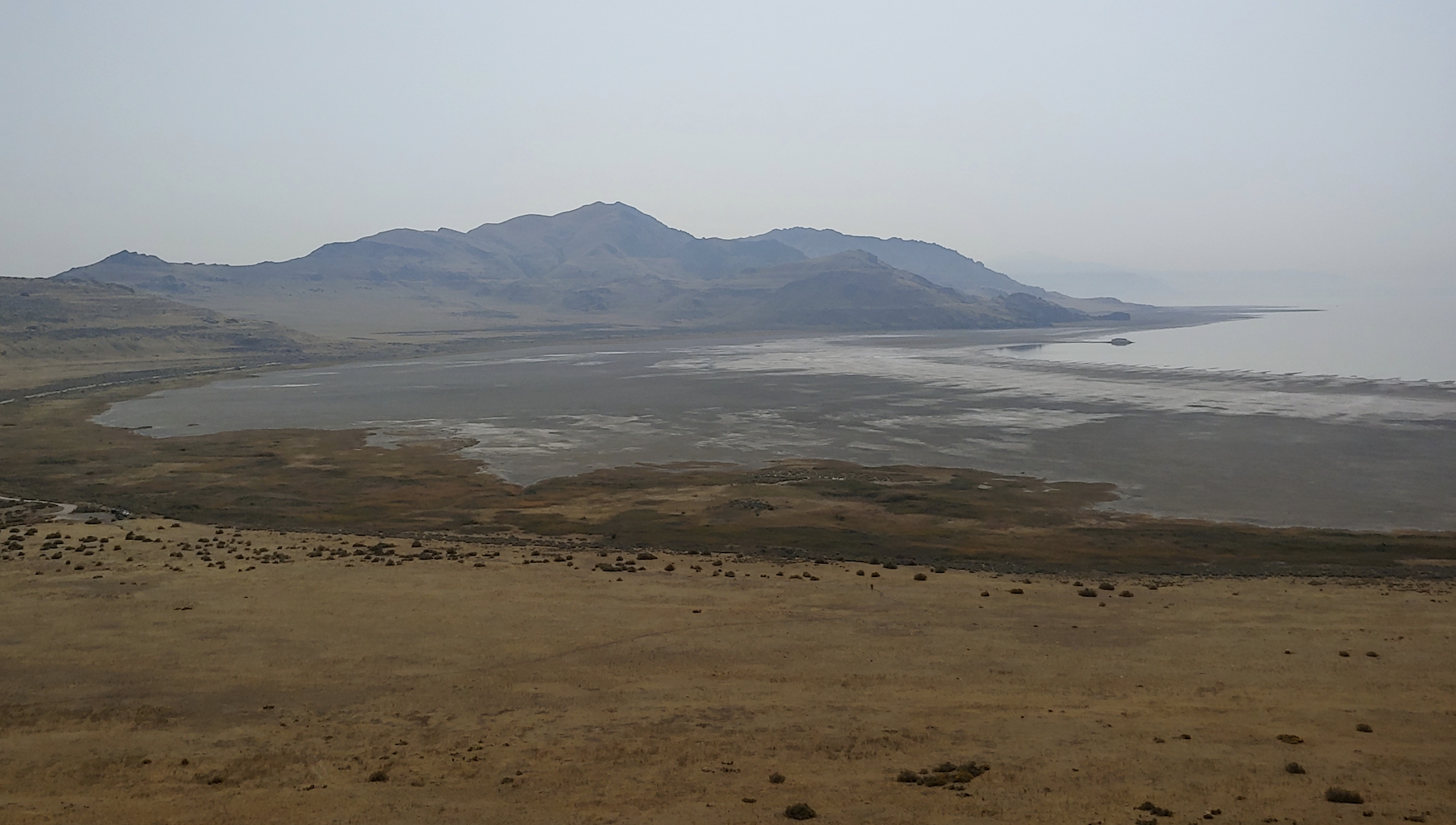
The local impacts on Hansel Valley are split between groundwater depletion and unprecedented thermal pollution:
● Aquifer Depletion: Historical and current agricultural pumping has already severely strained the local aquifer, reducing the natural spring flows supplying the Locomotive Springs Wildlife Management Area by 80% since the late 1960s. Converting agricultural water rights to power generation accelerates this depletion.
● The Thermal "Heat Island": An analysis by Utah State University physics professor Robert Davies highlights an enormous thermal crisis. The combined heat from the computing equipment (9 GW) and generator waste heat (7 GW) would release 16 GW of thermal energy directly into the local environment. This is the energetic equivalent of dumping 23 atom bombs worth of heat into Hansel Valley every single day. Professor Davies estimates this thermal load will spike daytime temperatures by 2°F to 5°F and nighttime temperatures by a massive 8°F to 28°F. These extreme increases will elevate ambient nighttime temperatures completely above normal regional dew points, preventing nightly condensation from occurring. Because warmer air holds more moisture, this localized heating will cause severe desiccation (drying) across the valley, decimating local agriculture, damaging the immediate ecosystem, and aggressively accelerating evaporation in the Great Salt Lake's northern arm.
6. Conclusion and Strategic Outlook
The Stratos Project presents Box Elder County with an unprecedented governance challenge, balancing immense economic scale against profound environmental and structural risks. Because the MIDA framework fundamentally alters traditional local zoning vetoes, the county cannot rely on standard land-use denials to manage the project’s impact. Furthermore, the narrowing of "public welfare" reviews under HB 60 shifts the regulatory battleground away from generalized community opposition at the state water-rights level.
Consequently, the county’s true leverage now rests on rigorous administrative execution and data-driven accountability. By aggressively utilizing the transparency and reporting mandates of HB 76, Box Elder County can establish an exhaustive, fact-based record of infrastructure constraints, water utility strain, and operational compliance. Holding the developer strictly accountable to these statutory disclosures provides the county with its most legally defensible mechanisms to delay, condition, or reshape project approvals.
Concurrently, the emerging grassroots citizen referendum introduces a powerful democratic wildcard. While a ballot challenge face complex legal preemption hurdles and the certainty of protracted corporate litigation, it underscores the deep community concern surrounding the project's staggering energy and thermal footprint. Ultimately, protecting the region's long-term environmental health—specifically the fragile hydrology of Hansel Valley and the recovery of the Great Salt Lake—will require the county commission and its residents to maximize every available legal, legislative, and factual lever at their disposal.